Stanford neuroscientist Andrew Huberman‘s podcast, Wim Hof’s documentaries, social-feed videos of people jumping into icy water — since 2020, cold plunging has gone global. “Dopamine 250%”, “brown fat activation”, “immune boost” — the claims pile up. But when you read the RCTs and meta-analyses, some claims hold up and others are clearly oversold. There is also a result you do not see in most podcasts: cold-water immersion after resistance training blunts muscle growth. Goal-dependent use matters.
Conclusion: Mood and alertness at Level 2. Metabolism and longevity at Level 3–4. Bad idea right after strength training.
[Level 2 (mood/alertness) / Level 3–4 (metabolism/longevity)] [Lifestyle] [Conditionally recommended]
2–5 minutes in 3–10 °C water reliably produces short-term improvements in mood and alertness in multiple RCTs (Level 2). On the other hand, brown-fat-mediated metabolic gains are small in absolute terms (Level 3), and “lifespan”, “immune boost”, and “hormonal optimization” claims are essentially unproven in humans (Level 4). Importantly, cold immersion immediately after resistance training reduces hypertrophy and strength gains — high-quality, reproducible evidence. If you lift, do not chill afterward.
❄️ What Is Cold Plunging?
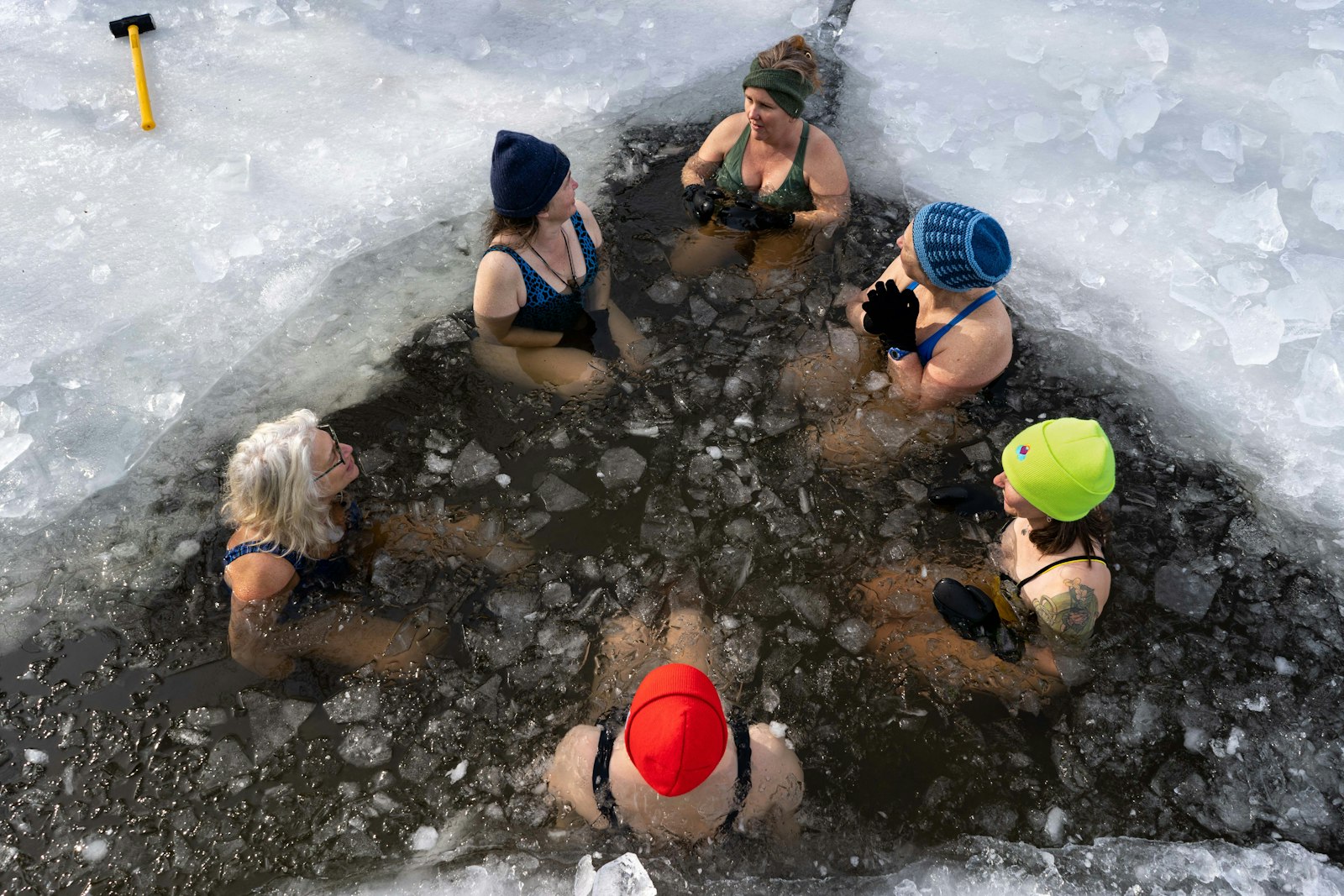
“Cold plunge” = immersion in 3–15 °C water for 2–10 minutes, body submerged below the neck. Nordic cultures have practiced this for centuries; the global boom started around 2020.
Common variants:
- Wim Hof Method: cold + breathwork + meditation. Founded by Wim Hof.
- Huberman Lab Protocol: ~11 minutes total per week (e.g., 3 min × 4 sessions). Popularized via Huberman Lab podcast.
- Sauna → cold plunge (contrast): Nordic tradition, recently re-popularized by Joe Rogan and others.
- Cold showers: simplest entry point. 30 seconds to 3 minutes.
Home cold-tub products (e.g., Plunge): roughly $3,000–6,000. Post-COVID market estimated in the hundreds of millions of dollars.
📊 Effect Sizes & Key Studies
1. Mood and alertness (Level 2 — real but short-term)
- Yankouskaya et al., Biology 2024: healthy adults, 5-minute cold immersion produced significant improvements in mood, vigor, and alertness. Effect persisted for hours.
- Mechanism: cold stress acutely raises noradrenaline (~500%) and dopamine (~250%). This is the source of Dr. Huberman’s “dopamine 250%” line.
- For long-term mood and depression effects, large RCTs are lacking — Level 3 at most.
2. Immune function and sick days (Level 3 — suggestive)
- Buijze et al., PLOS ONE 2016: 3,018 participants, cold shower 30–90 seconds for 30 days. Sickness absence dropped 29%. But the number of people who got sick was unchanged (symptoms milder, or pushed through to work).
- Šrámek et al., 2000: short-term changes in immune markers (lymphocytes, cytokines).
- Not strong enough to assert “immune system strengthened” in any rigorous sense.
3. Metabolism: brown fat activation and fat loss (Level 3)
- Cold exposure activates brown adipose tissue — well established.
- But the extra calorie burn from cold plunging is at most tens of kcal per session — clinically trivial for weight management.
- 2024 meta-analysis: “no significant improvement in body weight, body composition, or insulin sensitivity from cold immersion.”
- “It boosts metabolism” is technically true but practically meaningless for weight loss.
4. Recovery and exercise performance (Level 2 — but counterproductive for hypertrophy)
- Roberts et al., J Physiol 2015: cold immersion after resistance training significantly reduced muscle hypertrophy and strength gains (roughly half the placebo gain).
- Fyfe et al., Sports Med 2019: meta-analysis of multiple RCTs confirms.
- For hypertrophy goals, avoid post-workout cold.
- Exception: in endurance sports requiring acute recovery for tomorrow’s competition, cold immersion is useful — why elite endurance athletes use it.
5. Cardiovascular and lifespan effects (Level 4)
- “Cold plunging extends lifespan” — no long-term human cohort data exists.
- Cold exposure does not have the equivalent of Finland’s large sauna cohorts.
⚠️ Cautions and Real Risks
1. Cardiovascular risk
Cold causes rapid peripheral vasoconstriction with acute spikes in blood pressure and heart rate. For people with hypertension, heart disease, or cerebrovascular disease, this carries heart attack and stroke risk. If you are over 65, consult a physician first.
2. Cold shock response and drowning
Sudden cold immersion triggers an involuntary gasp reflex. Inhaling water from this reflex causes drowning. Always enter slowly in a controlled setting. Open water (rivers, lakes) is genuinely dangerous.
3. Hypothermia
Sessions over 15 minutes or in water below 3 °C can drop core temperature into life-threatening territory. Use a timer.
4. The “Dr. Huberman 11 minutes” number is a rough heuristic
The “11 minutes per week” prescription is extrapolated from a couple of papers, not validated in a dedicated RCT. Dr. Huberman himself describes it as a guideline. Treat it as such.
5. Reading “dopamine 250%”
The number is real, but it is the same category of acute stimulant response as caffeine, exercise, or sexual arousal. It is not “therapeutic dopamine supplementation.”
6. If hypertrophy is your goal — avoid after lifting
Bears repeating: if muscle growth is the goal, do not cold-plunge immediately after resistance training. Move it 6+ hours away from your workout, or to a different day.
🎯 How to Start (If You Want To)
- Start with the shower: do not jump straight into an ice tub. Cold shower 30 seconds, scale up gradually (30 sec → 1 min → 2 min → 3 min).
- Use 10–15 °C to start: even experienced practitioners rarely need under 5 °C. There is no evidence that colder is more effective.
- Frequency: 2–3 sessions per week, 10–15 minutes total. More does not improve outcomes per the data.
- Timing: morning. Leverages alertness boost. Evening sessions may disrupt sleep.
- Breathing: initially shallow and fast. Settle into slow nasal breathing. Wim Hof breathwork is advanced.
- Never solo: especially in open water — always have a spotter.
- If combining with resistance training: separate by 6+ hours or do on different days.
Should you buy a home cold tub?
- $3,000–6,000 Plunge-style products are expensive. Cost-to-evidence ratio is poor.
- Alternative: bathtub + ice can hit 10–15 °C just fine.
- Or: a cold shower delivers roughly 80% of the practical benefit.
👥 Who Should Try / Who Should Not
May be worth trying:
- People needing more consistent morning alertness or mood stability
- Endurance athletes needing acute recovery for next-day competition
- Those exploring adjunct approaches to depressive symptoms (not a substitute for treatment)
- Those interested in deliberately training stress tolerance
Should not:
- Hypertension, heart disease, cerebrovascular disease, arrhythmia history
- Pregnancy
- Over 65 with cardiovascular risk
- Primary goal is muscle hypertrophy (especially post-workout)
- Raynaud’s syndrome or cold sensitivity disorders
📝 Summary
- Short-term mood and alertness improvement is Level 2 — reliable.
- Immune, metabolism, and lifespan claims sit at Level 3–4 — frequently overstated.
- Cold immersion immediately after lifting blunts muscle gains (Level 2, reproducible).
- To start: cold showers 30 sec → gradually longer; cap at ~15 min/week.
- Skip the expensive cold tub. Bathtub + ice or a cold shower is enough.
- Cardiovascular risk → physician consultation is non-negotiable.
📚 References
- Yankouskaya A, et al. Short-term head-out whole-body cold-water immersion facilitates positive affect. Biology. 2024.
- Buijze GA, et al. The Effect of Cold Showering on Health and Work. PLOS ONE. 2016;11(9):e0161749.
- Roberts LA, et al. Post-exercise cold water immersion attenuates acute anabolic signalling and long-term adaptations in muscle. J Physiol. 2015;593(18):4285–4301.
- Fyfe JJ, et al. Cold Water Immersion as a Recovery Modality. Sports Med. 2019;49(Suppl 1):113–117.
- Šrámek P, et al. Human physiological responses to immersion into water of different temperatures. Eur J Appl Physiol. 2000;81(5):436–442.
- Tipton MJ, et al. Cold water immersion: kill or cure? Exp Physiol. 2017;102(11):1335–1355.
⚠️ Disclaimer
- This article is based on peer-reviewed literature but is not a substitute for medical advice.
- People with cardiovascular disease, hypertension, or cerebrovascular conditions should consult a physician first.
- Information current as of May 2026.